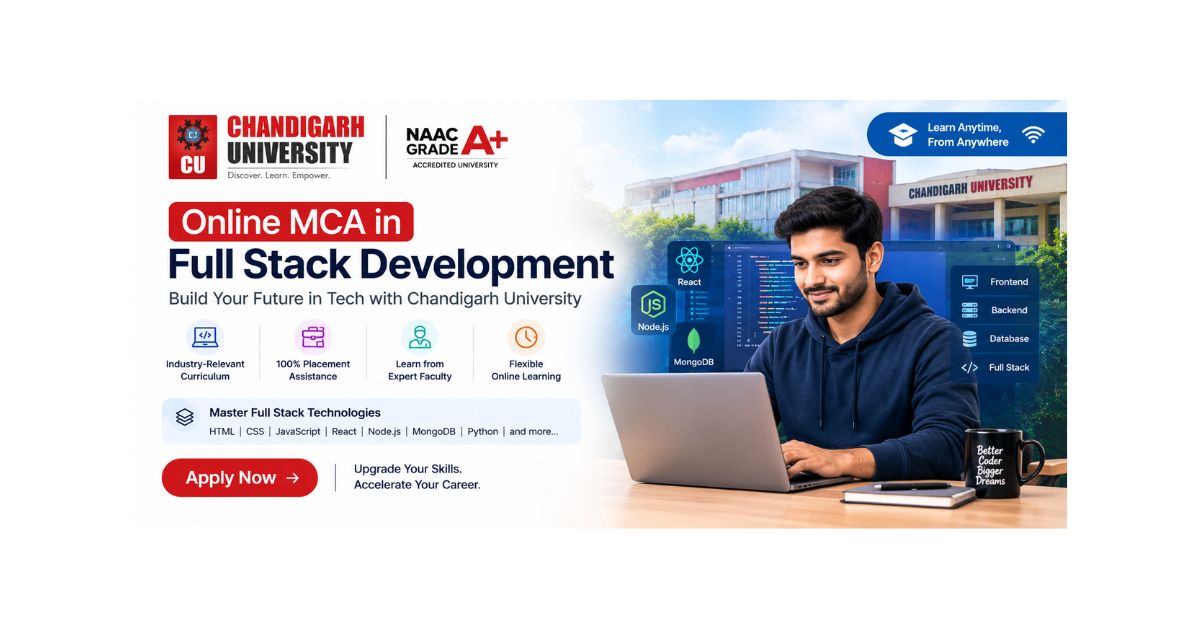
Online MCA in Full Stack Development at Chandigarh University
There is never-ending advertisement for online post-graduate degrees, and in most cases, the language used is more or less the same regardless of which university it emanates from. Thus, rather than using the usual brochures, this essay tries to find out what is factual concerning the Online MCA in Full Stack Development offered by Chandigarh University; eligibility criteria, fee range on various admissions sites, and accreditation of the program are among those facts that differ from one source to another. However, take this essay as a foundation for your own investigation since fees and admission details vary every year, and the only reliable source will be the university itself.
Join 25,000+ Online Learners
Get personalized fee & admission guidance from our experts within 24 hours. Save up to 25% with an early bird scholarship!
What This Program Actually Is
Online MCA in Full Stack Development is a postgraduate course that is offered by the online and distance learning department of Chandigarh University. This course offers a Master of Computer Applications degree in the same way as the campus-based course does, except for the mode of studying the course, which is through a learning management system rather than physically attending lectures.
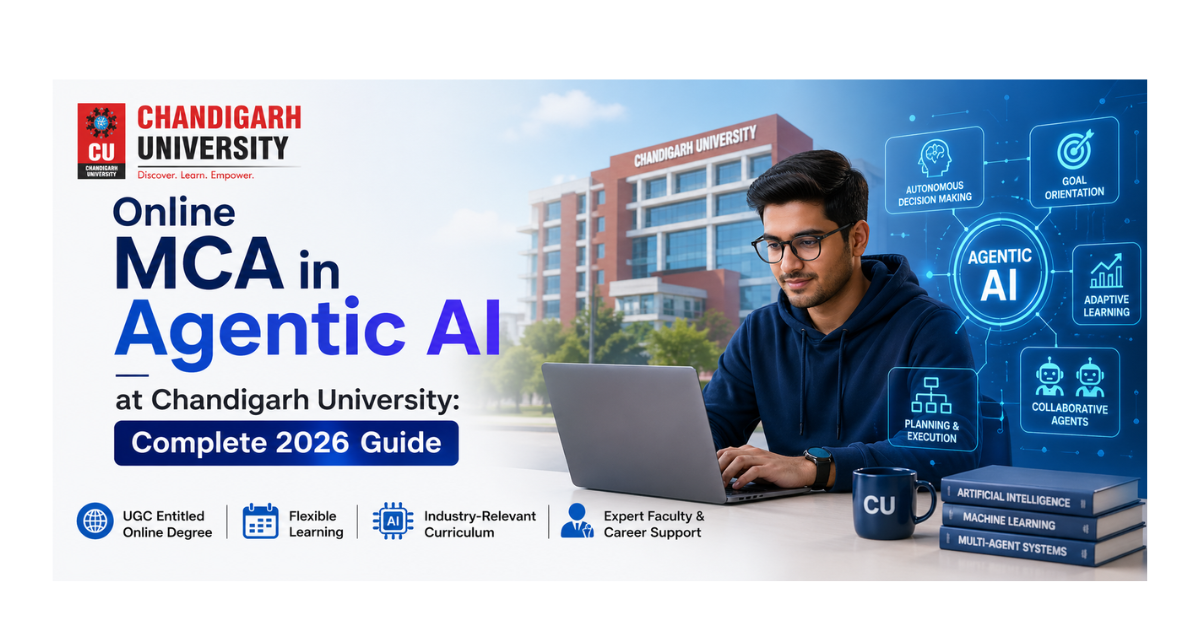
Full Stack Development is one of the many specializations that can be studied under the online MCA program. The other common specializations are Cloud Computing, Data Analytics, Artificial Intelligence & Machine Learning, and Agentic AI during specific intake sessions. All these specializations have an MCA core in the initial semesters and then proceed with their respective subject area courses.
Why Full Stack Development as a Specialization Makes Sense Right Now
When any engineering manager is asked what prevents a small team from performing efficiently, he will probably point out the handoff problem. A programmer who knows nothing other than the interface layer needs someone else to do the database work, and so on and so forth. In case of full stack developers, this problem diminishes significantly since they can switch between layers of applications themselves.
This is the rationale behind this specialization, where you get training not only in web development, but also in front-end interfaces, back-end logic, databases, and APIs. Whether or not this specialization will help you land a job of your dreams is entirely up to you, and depends on whether or not you will do some programming on your own in addition to getting a degree. Without a portfolio, "Full Stack Development" on your transcript means nothing.
Eligibility: Who Can Actually Apply
Academic Requirements
It is clear from the admissions list that a bachelor’s degree is the minimum prerequisite, preferably in computer science or any other related field like BCA, B.Sc in Computer Science or IT. The minimum percentage of 50% for graduation level is a common requirement found in almost all references consulted for writing this paper. Another prerequisite which is very common is the study of mathematics either at the 10+2 level or even for the bachelor’s degree.
Relaxations and Exceptions
Final year students of the qualifying degree program would normally remain eligible to apply, as long as they provide the certificate of passing once the result is declared. Candidates belonging to reserved categories can get relaxed percentages on the marks criteria, which is normal in all Indian universities. Nothing in this regard must be considered as hard and fast rule and you should always ask directly from the admissions office.
Duration and Semester Structure
The curriculum is divided into a two-year duration course spread over four semesters, which is also the typical pattern followed in most MCA courses in India, either online or offline. There have been cases where some websites have stated that there may be a provision for extending the course duration to accommodate individuals who may require more time to balance studies and work.
Fees: What You're Really Paying
Registration and Semester Fees
This is the point where there really is disagreement between sources, hence a need to outline the full spectrum of costs rather than using one figure and calling it the definite cost. The semester fee quoted from various admission portals stands at about ₹25,000 to ₹29,063. In addition to this, there is also a non-refundable, one-off registration fee that amounts to approximately ₹1,000. The total cost of the program in four semesters would be in the range of ₹1,00,000 to ₹1,17,000.
EMI and Payment Options
Almost all the sources cite EMI options, allowing you to pay your semester fees in monthly installments rather than one lump sum. This is definitely a valuable choice for you, especially if you are funding your education yourself amid other financial obligations. Like above, it is advisable to check out the latest information regarding the EMIs from the college itself or from an official counseling agent.
Accreditation and Recognition
UGC-DEB and AICTE Approval
Here comes the crucial section that will decide if the degree you have taken will be worth anything down the road when you will apply for any government examination or higher education or even a job in foreign countries. In all the sources reviewed for this article, one finds UGC-DEB eligibility and AICTE recognition, which are two essential things required for an online technical degree in India.
NAAC A+ Grading
The Chandigarh University has earned an A+ grade rating from the National Assessment and Accreditation Council. However, this grade is indicative of the overall excellence of the university and not necessarily of the program in question, but still is a good indicator to go by when comparing several universities.
Talk to an Admissions Counselor
Get personalized guidance for program selection, fees & admission process.
How Classes Actually Work
Live Sessions vs Recorded Lectures
Course delivery is normally a combination of live online classes along with access to lectures. Live classes provide an opportunity to raise any questions on the spot, which becomes very important in such a practical course like full-stack development rather than in any theoretical course. Lectures recorded during live classes become your backup plan for those days when your work or internet connection plays truant.
Assignments, Projects and the Capstone
Anticipate assignments, quizzes, and programming tasks throughout every semester with the final one devoted to a capstone project based on a practical challenge as opposed to a theoretical example from your textbook. This capstone should not be disregarded only due to its grade value, but because it will become the work that you can take to an interview.
What You'll Actually Study
Core Computer Applications Subjects
The basic curriculum includes the MCA courses that cover basics such as programming concepts, data structures, databases, computer networks, operating systems, and software engineering. This remains constant during the initial semesters irrespective of specialization chosen.
Full Stack Specific Modules
Apart from that, for the Full Stack Development stream, there are additional topics like front end frameworks, back end programming languages and frameworks, API designing, version control and deployment techniques. These curriculum details keep getting updated from time to time as per changes in the industry, hence you should fetch the latest curriculum details available at your university.
Career Scope After the Degree
Job Roles You Can Realistically Target
This path produces graduates who aspire to be developers of the following positions: full-stack developer, web developer, software engineer, and application developer. Some of them go on to specialize in front-end developer or back-end developer positions depending on which of the two sides proves stronger to them, while some move on to closely related positions.
Placement Support
Career counseling, resume building, and interview preparation are often part of the program as well. But keep your expectations realistic: career counseling from an online degree program is like having access to tools, not a job waiting for you. How useful it is for you will depend largely on how much you make of it.
How It Stacks Up Against a Regular On-Campus MCA
On-campus MCA will provide you with immediate faculty access, regular classes, and campus placement drives on your campus premises. Online MCA, on the other hand, offers you the benefit of studying without the need to relocate, and saves you the cost of relocating and, in most cases, offers lower tuition than the full-time on-campus one.
Each form has its own strengths and weaknesses; it all depends on personal choice. For example, in case you are working and unable to take time off from work, then opting for online MCA clears the roadblock for you. In case you are a fresher with free time and financial ease, you could opt for on-campus.
A Short Checklist Before You Apply
Before submitting an application or paying a registration fee, it's worth running through a few checks rather than relying on a third-party listing:
-
Confirm the current fee structure and payment schedule directly on the university's official admissions page.
-
Ask for the latest semester-wise syllabus, not a generic overview, so you know what tools and frameworks are actually being taught this year.
-
Verify UGC-DEB and AICTE approval status for the specific intake year you're applying under, since approvals are typically renewed periodically.
-
Ask what the placement support process actually involves: resume reviews, mock interviews, referral drives, or just a list of hiring partners.
-
Get the admission deadline in writing, since counselling platforms sometimes display outdated cycles.
Should You Actually Enroll?
This will all depend on the problem you need to solve. When you already have experience in computer applications, but need a proper, accredited process to become a full stack developer while earning money, then everything you need is here: approval from the University Grants Commission and the All India Council for Technical Education, an NAAC A+ rated college, flexible EMI charges, and a specialization that fits modern hiring trends.
When you think that the only thing this degree will give you is a job offer, you better change your expectations. No program gives guarantees like this. What it gives is an accredited degree and the curriculum. The practice in programming, the portfolio you'll create with it, and the networking you'll do during these two years are your responsibility.
Conclusion
The Online MCA in Full Stack Development offered by Chandigarh University is a legitimately accredited program choice for anyone trying to establish postgraduate qualifications and development skills while continuing on with their careers. It is, after all, a UGC-DEB and AICTE-accredited program that comes from a NAAC A+ rated university, has affordable fee payment choices via EMI and offers courses based on the demand in the market. However, the fee structure, course syllabi, and application deadline information provided by the various sources used for this article do differ significantly, so no information provided here is to be considered a substitute for information directly acquired from the university itself.