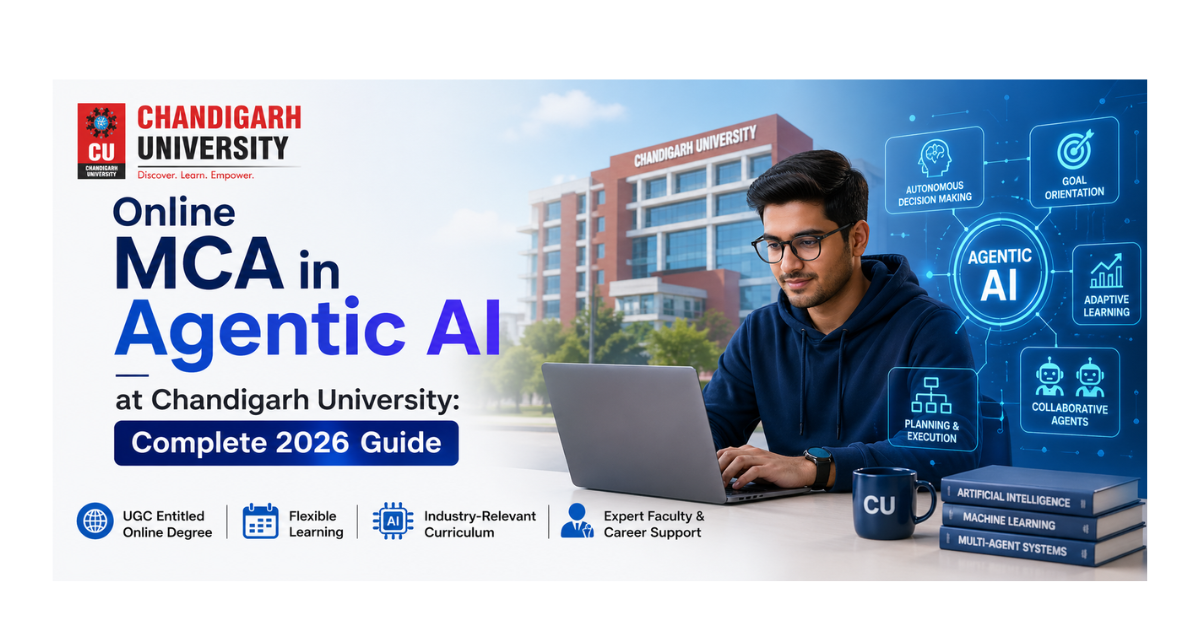
Online Master of Computer Applications (MCA) – Agentic AI at Chandigarh University
Here is a question worth sitting with for a moment. When was the last time you looked at a job description in the tech industry and did not see the words "AI," "machine learning," or "intelligent systems" somewhere in the requirements? If you are struggling to remember, that tells you something important about where the industry is headed and how quickly it is getting there.
The shift happening right now is not just about companies adding AI features to existing products. It is about a fundamental rethinking of how software works, how decisions get made, and what it means for a system to be truly intelligent. At the center of that shift is a concept called Agentic AI, and Chandigarh University has built a postgraduate program that puts this concept front and center.
The Online Master of Computer Applications with Agentic AI specialization is one of the most strategically timed academic programs to emerge from an Indian university in recent years. This article walks you through exactly what it covers, who it is right for, what your career could look like afterward, and how to get started.
Understanding the Online MCA with Agentic AI Specialization
Before anything else, it helps to understand what you are actually signing up for when you enroll in this program. The Online MCA at Chandigarh University is a two-year postgraduate degree in computer applications that you complete entirely through a digital learning platform. No relocation. No campus commute. No forcing your work schedule around a classroom timetable.
Join 25,000+ Online Learners
Get personalized fee & admission guidance from our experts within 24 hours. Save up to 25% with an early bird scholarship!
The Agentic AI specialization is what separates this particular MCA from dozens of similar programs available across the country. Rather than treating artificial intelligence as a passing topic in a broader curriculum, this specialization puts autonomous AI systems at the core of your learning journey in the second year, once you have built a solid technical foundation in the first.
How the Program Is Structured
The program runs across four semesters. During the first two semesters, students work through foundational subjects covering programming, data structures, database management, software engineering principles, and web technologies. This phase is intentionally thorough because the more advanced material in the second year builds directly on it.
From the third semester onward, the specialization in Agentic AI takes over as the primary focus. This is where students begin working with agent architectures, autonomous systems, language model integration, and multi-agent environments. The structure rewards students who commit to the process because every concept introduced in the early semesters feeds into something more sophisticated later on.
Alongside core subject courses, there are elective options that allow you to customize your path. Whether you want to move toward AI research, enterprise software development, or product-focused engineering, the elective system gives you room to shape the degree around your own goals.
Who Is This Program Built For?
This program was designed with a specific type of student in mind. That student is someone who already has a background in computing or a related field and wants to move meaningfully into the world of intelligent systems.
Software developers who keep hearing AI mentioned in sprint planning meetings but lack the formal knowledge to contribute at that level will find this program directly useful. Data analysts who want to step up from working with data to building systems that act on data will find a clear progression here. Fresh graduates from BCA, B.Sc. Computer Science, or Information Technology backgrounds who want to enter the job market with advanced credentials will benefit from having a specialization that hiring teams are actively looking for.
If you are someone who has genuine curiosity about how AI agents work, how autonomous systems make decisions, and what it takes to build something that can think and act without constant human instruction, this program will hold your attention from day one.
Why Chandigarh University Is a Credible Choice for Online MCA
Choosing a university for a postgraduate degree is not a decision to take lightly. Your degree will represent your academic credibility to employers for the rest of your career, so the institution behind it matters enormously. Here is why Chandigarh University holds up under that kind of scrutiny.
Accreditation, Rankings, and Academic Reputation
Chandigarh University has received a NAAC A+ grade, which is the highest tier of accreditation awarded by the National Assessment and Accreditation Council. This recognition is granted only after a rigorous evaluation of teaching standards, research output, student outcomes, and institutional governance. Earning an A+ puts Chandigarh University in the company of India's most academically credible institutions.
Beyond NAAC, the university has earned consistent placement in the QS World University Rankings and holds strong positions in India's National Institutional Ranking Framework (NIRF). These rankings reflect real performance across research, faculty quality, and graduate employability, not just self-reported metrics.
Don't Miss Your 25% Scholarship!
Our counselors will call you within 24 hours with the best fee & admission plan.
For students considering international career opportunities, the degree's credibility extends beyond Indian borders. Employers in the UK, Canada, the Middle East, and Southeast Asia are familiar with institutions that carry NAAC A+ and QS rankings, which makes your credential portable in a way that less recognized degrees simply are not.
Curriculum Designed With Industry Input
One of the most consistent criticisms of traditional education is the gap between what gets taught in classrooms and what companies actually need from new hires. Chandigarh University has worked to close that gap by involving industry professionals in the curriculum development process.
The case studies and problem sets embedded throughout the program are drawn from real organizational challenges, not textbook hypotheticals. Students work through problems that practicing AI engineers and software architects deal with in production environments. This approach means that by the time you complete your degree, you are not starting your professional learning from scratch. You have already worked through the kinds of challenges your future employers face every day.
Agentic AI – Why This Specialization Matters Right Now
The word "specialization" gets used loosely in academic marketing, but in this case it carries real weight. Agentic AI is not a rebranding of something that already existed. It represents a genuine and significant evolution in what artificial intelligence can do, and the timing of this program reflects a sharp awareness of where the industry is heading.
The Real Difference Between Reactive AI and Agentic AI
Most people's mental model of AI is still shaped by tools that respond to prompts. You type something in, the AI responds, and the exchange ends there. That model of AI, while powerful in its own right, is fundamentally reactive. It waits for you to do something before it does anything.
Agentic AI operates on a completely different principle. An AI agent perceives its environment, identifies a goal, breaks that goal into steps, takes action, observes the results of those actions, and adjusts its approach accordingly, all without needing you to guide each step. Think of the difference between a GPS that gives you directions when you ask and a system that monitors your calendar, notices your morning meeting location changed, checks live traffic, determines you should leave 20 minutes earlier, and sends you an alert before you even open the app. The second system is doing something genuinely agentic.
This shift matters because organizations are moving fast to deploy agents across their operations. Customer service, logistics, financial analysis, healthcare monitoring, content management, and dozens of other functions are being rebuilt around agentic systems. The engineers who understand how to build, test, and maintain these systems are among the most sought-after professionals in tech right now.
Key Subjects Covered in the Specialization
The subject lineup in this specialization is one of its strongest features. Each module builds on the previous one and connects directly to real-world applications.
AI Agents and Autonomous Decision-Making
This module covers the foundational theory and practical architecture behind AI agents. Students work through different agent types, from basic reflex-based systems to sophisticated goal-driven and utility-maximizing agents. The course goes further into multi-agent systems, where several AI entities operate within a shared environment, sometimes cooperating, sometimes competing, to achieve their respective objectives.
Planning algorithms, environment modeling, and agent communication protocols form the technical core of this module. Students leave it with both the conceptual understanding and the practical skills to design agent architectures that can operate reliably in complex, dynamic environments.
Machine Learning and Deep Learning Pipelines
A solid understanding of machine learning is non-negotiable for anyone working with AI agents, because agents rely on ML models to perceive their environment and make predictions. This module does not just cover how machine learning models work in isolation. It teaches students how to integrate models into larger workflows, how to manage training and evaluation cycles, and how to deploy models within production systems.
Students work with industry-standard frameworks and learn how to optimize models for speed and accuracy, troubleshoot performance issues, and update models as new data becomes available. These are practical pipeline management skills that are in constant demand at companies running AI at scale.
NLP, Large Language Models, and Tool Integration
Large Language Models have become the most visible component of modern AI agents, and this module gives students a thorough grounding in how they work and how to use them effectively. Students learn about model architecture, prompt engineering strategies, and fine-tuning techniques that allow LLMs to be adapted for specific tasks.
Importantly, the module goes beyond understanding LLMs as standalone tools. It covers how to integrate language models into agentic pipelines, including retrieval-augmented generation, function calling, and tool use patterns that allow agents to pull from external databases, trigger APIs, and respond to real-time data. This is advanced, applied knowledge that goes well beyond what most online AI courses cover.
What Career Paths Open Up After Completing This Program
The career outlook for graduates of this program is genuinely strong, and that strength comes from a combination of the credential itself and the specific skills the Agentic AI specialization develops.
In-Demand Job Roles You Can Pursue
Graduates from this program are qualified to pursue roles including AI Engineer, Machine Learning Engineer, NLP Developer, Autonomous Systems Architect, Conversational AI Specialist, AI Product Manager, and Software Engineer with AI integration focus. Each of these roles commands competitive salaries and carries strong long-term growth prospects.
For those interested in research and academia, the program also provides the depth of knowledge needed to pursue doctoral research, contribute to AI research labs, or take on teaching roles in computer science departments.
Sectors Actively Hiring Agentic AI Professionals
What makes this specialization particularly valuable is that its applications cut across virtually every major industry. Healthcare organizations are deploying AI agents for patient triage, diagnostic support, and clinical workflow automation. Financial institutions are building agents for fraud detection, regulatory compliance monitoring, and personalized investment advisory. EdTech platforms use agentic systems to create adaptive learning experiences that respond to individual student progress in real time.
Manufacturing and logistics companies are automating supply chain decisions using agent-based systems. Legal tech firms are using agents for document review, contract analysis, and compliance checking. Even government bodies and public sector organizations are beginning to invest in autonomous AI for public service delivery.
The result is a job market where your skills from this program are relevant across dozens of sectors, giving you genuine flexibility in choosing the industry and type of role that suits you best.
Admission, Eligibility, and Financial Details
Getting into the program is a clear, manageable process. Here is what you need to know before you apply.
Who Can Apply
The standard eligibility requirement is a bachelor's degree in Computer Applications (BCA), Computer Science, Information Technology, or a closely related discipline from a recognized university. The university also considers applicants from adjacent fields who have a strong quantitative background and demonstrable interest in computing. Specific percentage requirements at the undergraduate level should be confirmed directly through the official admissions portal, as these details are subject to periodic updates.
Step-by-Step Application Process
The entire application is completed online. You start by creating an account on Chandigarh University's official online education portal. From there, you fill in your academic history, upload required documents including mark sheets, degree certificates, and government-issued ID, and submit the completed form.
25,000+ Students Trust India's Top University
Join CU Online — NIRF ranked, NAAC A+ accredited & globally accepted degree at best fees.
After submission, the admissions team reviews your application. Many applicants are then contacted for a counseling session where a university representative walks you through the program in detail, answers your questions, and confirms that it aligns with your goals. Once your application is approved, you complete payment to secure your enrollment and gain access to the learning platform.
The entire process, from account creation to enrollment confirmation, can typically be completed within a few working days.
Fee Structure and Scholarship Opportunities
Chandigarh University has positioned the Online MCA as an affordable alternative to on-campus postgraduate education. The fee structure is competitive when measured against both on-campus equivalents and other online MCA programs from comparable institutions.
Merit-based scholarships are available for eligible applicants, and installment-based payment options are offered to reduce the financial pressure of paying the full fee upfront. For the most accurate and current fee information, the university's official website is the authoritative source, since figures can be revised between academic intakes.
The Day-to-Day Learning Experience
A common concern about online programs is whether the learning experience is genuinely engaging or whether it eventually feels like going through the motions alone. Based on how this program is designed, that concern has been taken seriously.
Live Classes, Flexible Lectures, and Mentor Support
Each week combines live instructor-led sessions with access to recorded lectures that can be revisited at any time. The live sessions are interactive, not passive. Faculty members facilitate discussion, pose problems to the group, and make space for students to ask questions in real time. This format keeps the experience closer to a classroom dynamic than a simple video library.
Mentorship is built into the program as well. Students have regular access to academic advisors and subject matter mentors who provide feedback on their work, help them work through challenging concepts, and offer career guidance as they move through the program. The peer community that forms within each cohort also turns out to be an underrated learning resource, since students come from varied professional backgrounds and bring different real-world knowledge to every discussion.
Real Projects That Build Your Portfolio
The most important practical component of the program is the capstone project completed toward the end of the second year. This project requires each student to design and build a complete Agentic AI solution that addresses a genuine problem. You define the problem, architect the solution, implement it using the tools and techniques learned throughout the program, and present it with documentation that explains your decisions.
This capstone becomes the centerpiece of your professional portfolio. When you walk into a job interview, you are not just talking about what you studied. You are showing what you built. That distinction makes a significant difference in how hiring managers evaluate your readiness for a role.
Industry-aligned assignments spread across all four semesters also simulate realistic workplace conditions, so the transition from student to working professional feels far less disjointed than it does for graduates of more theoretically focused programs.
Conclusion
The Online MCA with Agentic AI specialization at Chandigarh University sits at the intersection of two things that rarely align this cleanly in academic programs: strong institutional credibility and genuine curriculum relevance to where the job market is heading. Agentic AI is not a buzzword that will fade from industry conversations in a year or two. It is the direction in which the entire software development world is moving, and the professionals who understand it at a technical level are going to be in high demand for a long time.
If you have been waiting for the right moment to invest in your postgraduate education, or if you have been looking for a program that offers something more than a rehashed version of a traditional MCA, this program deserves serious attention. The credential is credible, the curriculum is current, and the career outcomes are backed by real industry need. That combination is harder to find than it should be, and when you find it, it is worth acting on.
FAQs
1. Can I complete the Online MCA with Agentic AI at Chandigarh University while working a full-time job? Yes, the program is structured specifically with working professionals in mind. Recorded lectures can be accessed on your own schedule, and live sessions are typically scheduled to accommodate people who work standard hours. Many enrolled students balance full-time employment alongside their studies without significant disruption to either.
2. Do I need prior experience in AI or machine learning before applying? Prior AI experience is not required. The first year of the program builds your foundation in core computer science concepts, and the AI-specific content is introduced progressively in a way that assumes no prior exposure to machine learning or agent-based systems. A background in basic programming will be helpful, but the curriculum is designed to develop your skills from the ground up.
3. How does the Agentic AI specialization compare to a standard MCA in terms of employability? A standard MCA provides solid computing credentials. Adding the Agentic AI specialization on top of that gives you a specific, in-demand skill set that standard MCA graduates typically do not have. In a job market where AI engineering roles are growing faster than the available talent pool, that distinction matters significantly when your resume is being reviewed.
4. Is the degree from Chandigarh University recognized internationally? Chandigarh University holds NAAC A+ accreditation and features in QS World University Rankings, both of which carry recognition among employers in multiple countries. Graduates have found the credential accepted in hiring processes across the UK, Canada, the Gulf region, and parts of Southeast Asia, though specific recognition can vary by employer and role.
5. What tools and programming languages will I work with during the program? The program centers heavily on Python, which is the dominant language in AI and machine learning development. Students also work with frameworks including TensorFlow, PyTorch, and LangChain, along with cloud-based deployment tools and APIs used for integrating large language models into real applications. The toolkit you build during this program reflects what is actually being used in production AI environments today.