How to Apply for an Online MBA Online: Step-by-Step Guide for 2026
Picture this. You have spent four or five years working, learning on the job, watching how decisions get made above you and thinking you could do it differently if given the chance. But every senior role you look at asks for an MBA. And every MBA you look at asks for two years of your life, a campus you cannot commute to, and fees that assume you have no rent to pay.
That is the trap a lot of working professionals and ambitious graduates find themselves in. An online MBA exists specifically to break that trap.
Join 25,000+ Online Learners
Get personalized fee & admission guidance from our experts within 24 hours. Save up to 25% with an early bird scholarship!
In India, the option has become genuinely credible. CU Online, the distance and online division of Chandigarh University, now offer a UGC-DEB-recognized MBA that runs entirely through a digital platform. You do not give up the degree. You do not give up the quality. You just stop being tied to a physical location. And the application process, once you understand it, is far less intimidating than most people expect.
This guide gives you the complete picture, from first-time research to confirmed admission.
What Is an Online MBA and Why Does It Matter?
The Basic Structure of an Online MBA Program
An online MBA runs across two academic years, divided into four semesters. Each semester covers a set of core management subjects and, depending on your specialization, includes elective modules specific to your chosen track. Classes are delivered through a combination of scheduled live sessions with faculty and recorded lectures you can access at any hour.
Assessments include assignments, projects, mid-semester tests, and end-semester examinations, most of which are conducted through proctored digital platforms. At CU Online, students interact with faculty, submit work, and access all study resources through a centralized learning management system designed for remote learners.
The degree certificate you receive after completing the program carries the Chandigarh University name and seal. It looks identical to the certificate a regular on-campus student receives because academically, it is the same qualification.
How Online MBAs Differ from Regular Campus Programs
The difference is in the delivery, not the depth. Campus programs assume you are present on a physical campus five days a week. They build a schedule around classroom lectures, library access, and face-to-face faculty interaction. Online programs replace those with digital equivalents that work around your availability rather than demanding it on fixed terms.
What you gain is the ability to keep working while you study. What you manage differently is self-discipline, since no one is physically checking whether you attended the 6 PM session. The learning outcomes, when the program is from a properly accredited institution, are comparable. And in 2026, most Indian employers have caught up with this reality.
Who Can Apply? Eligibility Criteria Explained
Minimum Academic Requirements
To apply for an online MBA at CU Online, you need a bachelor's degree from a university recognized by UGC. The minimum qualifying aggregate is generally 50%, though individual specializations may set their own thresholds. Your undergraduate discipline does not restrict you. Students from science, arts, commerce, and engineering backgrounds are all eligible to apply.
If you have not yet received your final degree certificate because results were recently declared, you can apply with a provisional certificate or a copy of your final semester mark sheet. Your admission will be formalized once verified documents are submitted.
Do You Need Work Experience?
No, not necessarily. CU Online's online MBA accepts both fresh graduates and working professionals. Some programs at other institutions require a minimum of one or two years of professional experience, but that is not a universal rule. Read the specific eligibility criteria for the program you want before drawing any conclusions.
If you do have work experience, use it. A background in industry gives you a practical lens through which to absorb MBA concepts, and it strengthens your overall application. If you are fresh out of graduation, your academic record, any internships you have completed, and any leadership roles in college activities become your primary application assets.
Language Proficiency for Indian and International Students
Indian students who have completed their graduation in an English-medium institution do not need to submit a separate language proficiency score. Your degree itself serves as evidence of English capability.
International applicants from countries where English is not the primary medium of education will typically need to submit an IELTS score of 6.0 or a comparable TOEFL result. Requirements for international students can be updated between admission cycles, so verify directly with CU Online's admissions team rather than relying on older sources for this specific detail.
How to Apply for an Online MBA: The Complete Step-by-Step Process
Step 1 - Identify Programs with Genuine Accreditation
Start here. Not with the application form. Not with the fee payment. Start by confirming that the program you are considering is offered by a UGC-DEB-approved institution.
The UGC-DEB, which stands for University Grants Commission's Distance Education Bureau, is the regulatory body that oversees the quality and legitimacy of distance and online higher education programs in India. Any online degree from an institution not listed on UGC-DEB's approved list is not considered equivalent to a regular university degree. This has direct consequences for government job eligibility, PSU recruitment, bank exam applications through IBPS and RRB, and even private sector roles that specify a recognized degree.
CU Online is listed as a UGC-DEB-approved institution. Chandigarh University additionally holds a NAAC A+ grade, which is the highest quality rating awarded by the National Assessment and Accreditation Council. These two markers together make the degree academically sound and employer-accepted.
After confirming accreditation, compare factors like curriculum structure, the specific subjects covered in your specialization, faculty credentials, student support systems, and what kind of career assistance the institution offers.
Step 2 - Pick a Specialization That Matches Your Career Plan
Your specialization is not just a label on your degree. It determines the kind of roles you are prepared for, the industry conversations you can enter with confidence, and the career direction you build over the next several years. Choosing a specialization because it sounds good rather than because it aligns with actual career goals is a mistake many applicants make and regret.
MBA Specializations Available at CU Online
Marketing is the right track if you want to work in brand management, digital advertising, consumer research, or product marketing. The curriculum teaches you how buying decisions get made and how companies build lasting customer relationships.
Finance suits those drawn to investment analysis, corporate budgeting, risk assessment, or banking. It is a numbers-heavy specialization that rewards analytical thinking and attention to precision.
Human Resources prepares you for roles in talent management, organizational development, employee relations, and HR policy design. It is the right choice for people who genuinely enjoy working with teams and understanding what drives human behavior in professional environments.
Operations Management builds skills around supply chain coordination, logistics planning, quality systems, and process efficiency. If you like understanding how businesses function at a structural level and finding ways to make them run better, this is your track.
Business Analytics has grown rapidly as a career field. It combines quantitative analysis with business interpretation, preparing graduates for roles that use data to inform strategy, product development, and operational decisions.
International Business covers cross-border trade, global market entry strategy, multinational finance, and managing across cultural differences. It suits those with ambitions to work in globally operating organizations.
Before deciding, look up actual job listings in the role you want. See what qualifications and skills those listings ask for. Then choose the specialization that builds toward them.
Step 3 - Read Admission Requirements for Your Chosen Program
Once you know which program and specialization you want, visit the official CU Online website and read the admission requirements for that specific track. Do not rely on information from third-party education portals because they frequently carry outdated details.
Look for the current year's minimum percentage requirement, whether any entrance test is needed, the document submission timeline, the fee structure, and the application window for your intended intake. CU Online's online MBA typically follows merit-based admission without an entrance exam requirement, but this should be confirmed for your intake year.
If anything on the official page is unclear, email or call the admissions team directly. Getting accurate information upfront saves considerably more time than sorting out problems after submission.
Step 4 - Prepare Your Documents Before Opening the Form
Most application errors happen when people try to gather documents in the middle of filling out the form. Avoid this entirely by preparing everything in advance.
Your document checklist should include graduation mark sheets for every semester, your degree certificate or a provisional certificate if the final degree is pending, Class 10 and Class 12 mark sheets, a valid government-issued identity proof, two recent passport-size photographs saved as digital files in the dimensions the portal specifies, an updated resume, and work experience certificates from current and previous employers if relevant.
Scan each document at a minimum of 300 DPI. Save files in the format the portal accepts, which is usually PDF for certificates and JPEG for photographs. Give each file a clear, logical name. A file named Finance_Degree_Certificate_2023.pdf is far easier to manage than IMG_3847.jpg when you are uploading six documents at once.
Check whether any documents need to be attested or notarized. Most online applications for Indian students do not require this at the application stage, but it is worth confirming for your specific program.
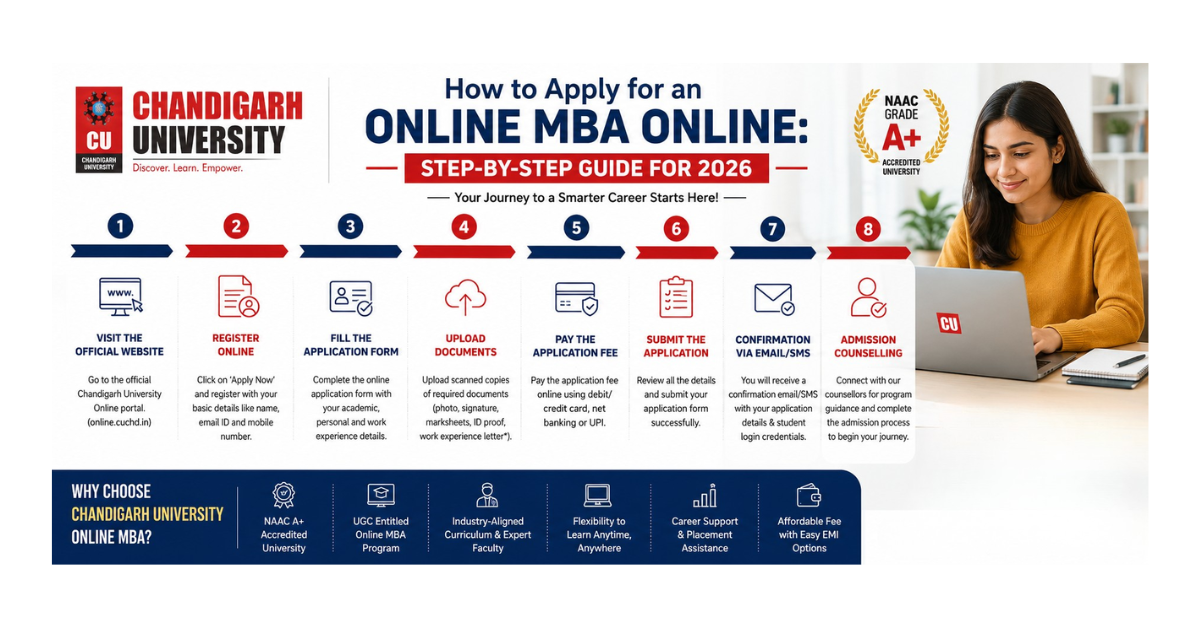
Step 5 - Register and Online Application
Go to the official CU Online website and create an applicant account using a personal email address you check regularly. All admission-related communication, including your offer letter, enrollment instructions, and fee payment confirmation, will arrive at this address.
Work through each section of the application form carefully. Enter your personal details, academic record, work history if applicable, and your specialization preference. Read each field label carefully before entering information. Errors in basic details like date of birth, name spelling, or contact number create verification problems later and can delay the entire admission process by days or even weeks.
Save your progress as you go. If the portal has a draft-saving feature, use it. Do not try to complete the entire form in one sitting if you have not gathered all your information in advance.
Step 6 - Upload Your Documents the Right Way
The document upload stage is where a surprising number of applications run into problems. Follow the instructions for each document section precisely. Upload each file in the section it belongs to, not as a combined attachment in a general uploads area.
Check the file size limit before uploading. Portals typically reject files above 2 MB per document. If your scanned file exceeds this, use a compression tool to reduce the size, but check that the compressed file is still fully legible before uploading it. A blurry or cut-off scan is grounds for document rejection, which forces a resubmission and delays your processing timeline.
Keep a folder on your computer with copies of every file you uploaded, named exactly as they appeared when you uploaded them. If you are asked to resubmit anything, you want to be able to respond quickly.
Step 7 - Complete the Application Fee Payment
CU Online accepts application fee payments through standard digital channels including UPI, debit and credit cards, and net banking. The fee amount is typically in the range of a few hundred rupees and is non-refundable regardless of whether you are offered admission.
Complete the payment only after verifying your form details one final time, since some portals lock the form after payment is processed. Take a screenshot of the payment success screen and save the receipt email. If a payment fails midway through processing, this documentation helps the admissions team trace and resolve the issue.
Some programs have fee waivers for specific applicant categories. Check whether any apply to your profile before proceeding to the payment step.
Step 8 - Final Review and Submission
Before submitting, go through every section one more time. Confirm that all required fields are filled, all documents are in the right upload slots, the payment is confirmed, and your contact details are accurate.
Once you submit, the system will generate a confirmation with an application reference number. This number is your primary identifier for all follow-up communication with the admissions team. Save it in two places, your email and a document on your device.
After submission, typical processing time at CU Online runs between two and four weeks, after which you will receive either an offer of admission or a request for additional information or document clarification.
Full Document Checklist for Online MBA Admission
Educational Certificates You Will Need
Class 10 board exam mark sheet, Class 12 board exam mark sheet, mark sheets for every semester of your graduation, and either your degree certificate or a provisional degree certificate. If your university issues a consolidated mark sheet rather than individual semester sheets, that combined document along with your passing certificate is acceptable.
Professional and Supporting Documents
A current resume that clearly lists your academic background and any professional experience. If you have worked, include experience certificates from each employer. If the program requests recommendation letters, approach a former employer, senior colleague, or academic supervisor who has direct knowledge of your work and can write specifically about your capabilities.
Identity and Photograph Requirements
A valid government-issued photo identity document such as an Aadhaar card, PAN card, voter ID, or passport. For international applicants, a copy of a valid passport is mandatory. Recent passport-size photographs saved as digital files in the exact dimensions and file format specified on the application portal.
Writing an MBA Statement of Purpose That Actually Works
Not every online MBA program asks for a formal statement of purpose, but programs that do treat it as a real evaluation criterion, not a formality. It is the one part of your application where marks and certificates step aside and you get to make a case for yourself in your own words.
What a Good SOP Covers
A strong SOP begins with something specific rather than something general. Do not start by describing how business has fascinated you since childhood. Start with a real situation, a moment at work, a challenge you handled, a decision you observed, or a gap in your knowledge that you ran into directly. That kind of opening is grounded in actual experience and immediately signals that the writer has something genuine to say.
From there, move into your career goals. A good SOP names specific roles, industries, or transitions rather than vague aspirations like leadership or growth. Describe where you are now, where you want to be in three to five years, and how this particular MBA program serves as the bridge between those two points.
Then connect your goals to the specific institution. Why CU Online? What does the curriculum offer that aligns with your direction? Which specialization fits and why? Admissions reviewers can tell when an SOP has been personalized for their program versus recycled from a previous application.
Close with a brief statement about what you bring to the program and how your background might contribute to discussions, group projects, or peer learning within the cohort.
What Kills an Otherwise Strong Application
Generic language is the most common problem. Phrases like passionate about business or committed to excellence appear in hundreds of SOPs. They communicate nothing specific and leave no impression. Replace every vague phrase with a concrete detail.
Grammatical errors are the second most damaging issue. They signal carelessness to reviewers who are looking for business professionals capable of clear written communication. Read your SOP aloud, ask someone with strong writing skills to review it, and use a grammar checking tool before submitting.
The third problem is an unclear narrative. If a reviewer finishes reading your SOP and cannot summarize what you want and why you are applying, the document has failed. Every paragraph should connect back to the central purpose of explaining who you are, what you want, and why this program is the right vehicle.
Planning Your Timeline: When Should You Start?
The Right Window to Begin Your Preparation
Six months before your target intake is the practical starting point for most applicants. This window gives you enough time to research programs thoroughly, gather documents that may take time to retrieve such as old mark sheets or experience certificates, write and revise your SOP without rushing, and handle any unexpected complications before the deadline.
Don't Miss Your 25% Scholarship!
Our counselors will call you within 24 hours with the best fee & admission plan.
Applicants who start two weeks before the deadline almost always submit incomplete applications, miss documents, or rush through the SOP in a way that weakens it. The preparation period is not bureaucratic overhead. It is what separates a strong application from a mediocre one.
Understanding Intake Cycles and Deadlines
CU Online typically runs two main admission cycles each year. Applications for the January intake usually open around September and close sometime in November or December of the previous year. Applications for the July or August intake generally open in February or March and close between May and June.
Some programs also operate on a rolling admissions basis, meaning seats are allocated as applications arrive rather than being held until a single cutoff date. In rolling admissions, there is a direct relationship between how early you apply and your chances of securing a seat before the cohort fills up.
Exact dates change between academic years. The only source you should rely on for current deadlines is the official CU Online website or a direct response from their admissions team.
Understanding the Full Cost of an Online MBA
Application Fee Breakdown
The application fee for most online MBA programs in India falls between Rs. 500 and Rs. 2,000. This charge is paid at the time of form submission, is non-refundable, and is separate from your tuition. It covers administrative processing and is the same whether or not you are ultimately offered admission.
Program Tuition: What to Realistically Budget
Online MBA programs at UGC-DEB-recognized universities in India are priced broadly between Rs. 60,000 and Rs. 2,50,000 for the complete two-year duration. CU Online falls within this bracket and is generally positioned as an affordable option relative to private residential MBA programs that can cost several times more.
Many programs, including those at CU Online, offer semester-wise or installment-based payment options. If paying the full amount upfront is not feasible, confirm whether an EMI or staggered payment plan is available and what the installment schedule looks like.
Verify the current fee structure directly on the official website before budgeting, as tuition fees are reviewed periodically.
Hidden Costs Most Students Overlook
Technology requirements are the most overlooked budget item. A reliable laptop and a stable broadband connection are not optional when your entire degree is delivered online. If your current setup is not up to the task, factor in an upgrade.
Some universities charge a technology fee or portal access fee in addition to tuition. Study materials at CU Online are typically provided digitally within the program fee, but you may want to supplement with reference books or additional online courses for your specialization, particularly in fields like Business Analytics or Finance where supplementary practice sharpens your skills considerably.
What Makes an Effective Application Different from a Poor One
Academic Record
Your undergraduate percentage is the most visible academic signal in your application. A strong academic record above 60% is a clear positive marker. If your marks are closer to the minimum threshold, every other part of your application needs to compensate by being noticeably strong.
Work Profile and Achievements
A resume that lists duties is forgettable. A resume that lists outcomes is memorable. If you managed a team, say how many people. If you grew a metric, say by how much. If you implemented something, say what changed as a result. Specific achievements give admissions reviewers something concrete to evaluate.
Personalization and Genuine Intent
Applications that clearly reflect thought about the specific program and institution stand out from applications that could have been sent to twenty different universities with the same text. Personalization is not just about adding the university's name to your SOP. It is about demonstrating that you have read the curriculum, considered the specialization carefully, and have a genuine reason for choosing this particular path.
On-Time Submission
Set your personal submission target at least a week before the official closing date. This buffer absorbs technical delays, resubmission requests, and last-minute document issues. The admissions team processes a high volume of applications near the deadline, and early submissions often receive faster attention.
Mistakes That Quietly Ruin Online MBA Applications
Skipping the Accreditation Check
Some applicants discover their program is not UGC-DEB recognized after they have already enrolled and paid a semester of fees. Verifying accreditation takes fifteen minutes on the official UGC website. Not doing it is a mistake with consequences that are difficult and expensive to undo.
Incomplete Document Packages
An application missing even one required document is either rejected or held pending, which can push your enrollment to the following intake. Use the official checklist from the CU Online website and confirm every item is present before submission.
Copy-Paste Applications
Resumes that contain general duties without any specific accomplishments, cover letters that address the incorrect institution, and SOPs that replicate templates from the internet are all indicators that the applicant did not put real effort into the application. These patterns are easy for experienced admissions reviewers to recognize and they work against you.
Last-Minute Submissions
When thousands of candidates submit simultaneously close to the deadline, portal servers slow down. Uploads fail. Payments time out. What would take five minutes on a quiet afternoon takes forty-five stressful minutes on the last day. There is no advantage to submitting late and significant risk to avoid.
Real Advantages of Choosing an Online MBA in 2026
Study Without Pausing Your Career
The structure of an online MBA is built around the reality that most students have other commitments. Evening live sessions, weekend classes, and on-demand recorded lectures mean your study schedule fits around your work calendar rather than requiring you to replace it. Many students find that the concepts they study in an evening session directly apply to a situation they encounter at work the next morning, which accelerates both learning and performance.
What the Degree Opens Up Professionally
A postgraduate management degree from a recognized institution removes a barrier that holds many professionals back. Senior roles across industries increasingly require an MBA for consideration, and the degree signals a level of business knowledge and commitment to professional development that a bachelor's degree alone does not communicate. For those aiming at management tracks in banking, consulting, operations, marketing, or HR leadership, the MBA is often the credentialing step that makes the difference.
Peer Learning Across Industries
One of the less-discussed benefits of an online MBA cohort is the diversity of professional backgrounds represented. When your study group includes someone from logistics, someone from media, someone from a startup, and someone from a bank, your discussions about marketing strategy or financial planning gain dimensions that a single-industry cohort cannot offer. That cross-sector perspective is practically useful in management careers where understanding multiple business contexts is an asset.
The Financial Case for an Online MBA
The cost difference between an online MBA and a residential program becomes even more significant when you factor in continued employment during study. While a campus student pays both tuition and living costs while giving up their salary, an online MBA student pays tuition only, and continues drawing their income throughout the program. When you account for salary increases that typically follow an MBA, most graduates recover the program cost within two to three years.
Honest Assessment: Is an Online MBA Worth Pursuing in 2026?
How Indian Employers View Online Degrees Today
The skepticism that once surrounded online degrees in Indian hiring has diminished considerably. Most mid-sized and large Indian companies, along with a growing number of multinational employers with India operations, now assess candidates from UGC-DEB-recognized online programs on the same terms as regular degree holders. This shift has been driven partly by the normalization of remote work and digital learning over the past several years and partly by the improving quality of accredited online programs.
The distinction that still matters is accreditation. A degree from CU Online, backed by UGC-DEB recognition and Chandigarh University's NAAC A+ accreditation, is treated very differently by employers compared to a degree from an unrecognized or loosely affiliated institution. Accreditation is the factor that determines whether your degree opens doors or raises questions.
Realistic Salary Expectations Post-MBA
MBA salary outcomes in India vary substantially based on specialization, prior experience, the specific employer, and the city. Entry-level management roles for fresh MBA graduates typically start between Rs. 5 and 8 LPA. Professionals who combine an MBA with three to five years of prior work experience can realistically target roles in the Rs. 10 to 18 LPA range depending on their specialization and sector. Business Analytics and Finance tend to command higher starting points than some other tracks, reflecting current market demand.
The MBA does not automatically guarantee a salary jump. What it does is remove the qualification barrier for roles that require a postgraduate degree and position you more competitively for conversations about compensation at that level.
What the Degree Does for You Over Ten Years
The longer-term impact of an MBA is harder to quantify but arguably more significant than the immediate salary movement. Business management education builds a way of thinking about organizations, markets, finance, and people that stays with you. Decision-making frameworks, financial literacy, strategic analysis, and the ability to manage teams and competing priorities are capabilities that compound over a career.
Professionals who complete an MBA in their late twenties or early thirties often attribute their mid-career positioning less to a single job change and more to the cumulative effect of thinking differently about the problems they encounter. That kind of compounding return is what makes the degree worth the investment, particularly when the cost and disruption are as manageable as they are with a well-structured online program.
Conclusion
Applying for an online MBA in 2026 comes down to preparation, honest self-assessment, and making one critical decision correctly at the start, which is choosing an accredited institution.
Everything else in this guide is manageable if you approach it methodically. Confirm UGC-DEB recognition before anything else. Choose a specialization based on where you actually want to go professionally, not what sounds impressive. Prepare your documents before you open the application form. Fill the form carefully, upload documents correctly, submit with time to spare, and write an SOP that reflects genuine thought rather than borrowed language.
25,000+ Students Trust India's Top University
Join CU Online — NIRF ranked, NAAC A+ accredited & globally accepted degree at best fees.
CU Online gives you a credible, structured path to a full MBA degree that works around your existing life. The degree carries the academic standing of a NAAC A+ accredited university and is recognized by employers across India and beyond.
What it requires from you is not financial sacrifice or career disruption. It requires organization, honest effort, and the discipline to follow through on a plan you make for yourself.
Author disclosure: This article was researched and written by the education content team based on publicly available information from UGC-DEB, NAAC, and CU Online program pages as of 2026. All figures for fees, salaries, and timelines are indicative. Readers should confirm current details directly with CU Online before applying.
Frequently Asked Questions
1. Can fresh graduates apply for CU Online's online MBA without any work history?
Yes. CU Online accepts applications from fresh graduates. Work experience strengthens a profile but is not a mandatory requirement for the online MBA program. A strong academic record and a thoughtfully written SOP can effectively make up for the absence of professional experience.
2. From application submission to admission confirmation, how long should I expect to wait?
Processing typically takes between two and four weeks after a complete application is submitted. Applications submitted during peak periods close to the intake deadline may take slightly longer. Applying early in the cycle generally results in a faster response.
3. Do Indian employers treat online MBA degrees the same as regular ones?
Most mid-sized and large employers do, provided the degree comes from a UGC-DEB-recognized institution with legitimate accreditation. CU Online's MBA meets this standard. The deciding factor is always the recognition status of the institution, not the delivery format of the program.
4. What is the complete list of documents needed to apply?
You will need graduation mark sheets for all semesters, your degree or provisional certificate, Class 10 and 12 mark sheets, a government-issued identity document, recent passport-size photographs in digital format, and a current resume. Work experience certificates are needed if you have prior employment. Some programs also require a statement of purpose or letters of recommendation.
5. Can students from outside India apply to CU Online's online MBA?
Yes. International students can apply. Additional requirements typically include a valid passport copy, English language proficiency scores such as IELTS or TOEFL, and documentation supporting the equivalency of foreign academic qualifications. Check the current international admissions guidelines on the official CU Online website for updated requirements.
6. What is the typical fee range for an online MBA at CU Online?
Online MBA programs from UGC-DEB-recognized institutions in India range broadly from Rs. 60,000 to Rs. 2,50,000 for the full program. CU Online is competitively positioned within this range. Confirm the exact current fee and payment plan options directly on the official website, as these figures are reviewed periodically.
7. Is a GMAT or CAT score necessary for applying to CU Online's online MBA?
No. CU Online uses a merit-based admission process for its online MBA. Your undergraduate academic percentage is the primary evaluation criterion. No entrance examination score is mandatory, though this should be confirmed for your specific intake year on the official admissions page.
8. Which MBA specializations does CU Online currently offer?
Available specializations include Marketing, Finance, Human Resources, Operations Management, Business Analytics, and International Business. The full and most current list of offered specializations is available on the CU Online program page. Verify before applying in case new tracks have been added or modified.
9. How long does the online MBA program run from enrollment to graduation?
The program is two academic years, structured across four semesters. This matches the standard duration of a regular campus MBA program in India.
10. Is it genuinely possible to manage full-time work alongside an online MBA?
Yes, and this is the design intent of the program. Live sessions at CU Online are typically scheduled during evenings or weekends. Recorded lectures allow self-paced study during whatever hours work for you. A large proportion of enrolled students are managing full-time employment alongside their studies.
11. How are examinations handled in an online MBA program?
Examinations are typically conducted through online proctored platforms. Verification happens through webcam monitoring and secure login credentials. Some institutions also arrange offline examination centers as an alternative. CU Online provides enrolled students with detailed examination instructions relevant to their specific intake cycle.
12. Is the degree certificate issued after an online MBA physically the same as a regular degree?
Yes. Graduates receive a physical degree certificate bearing the Chandigarh University name and institutional seal. The certificate does not indicate that the program was completed in an online format. It is the same credential issued to regular campus graduates of the same program.
13. Can an online MBA from CU Online be used when applying for government positions?
A UGC-DEB-recognized online MBA is treated as equivalent to a regular degree for many purposes in India, including certain government and public sector roles. Whether it satisfies the eligibility criteria for a specific government position depends entirely on what that particular job notification specifies. Always read the official recruitment advertisement before assuming eligibility.
14. What career support does CU Online offer to online MBA students and graduates?
CU Online provides career-oriented support including placement assistance, resume review sessions, mock interview preparation, and connections to Chandigarh University's broader recruiter network. Students also benefit from the university's industry partnerships and its alumni community, which spans multiple sectors and cities across India.
15. After enrolling, can I change my chosen MBA specialization?
Whether a specialization change is possible after enrollment depends on CU Online's policy for the specific intake. Some programs allow changes within a defined window at the beginning of the course. If you are uncertain about your choice before enrolling, speak directly with the CU Online admissions team to understand what flexibility, if any, is available to you.